

Article: Choosing the Right Fabric for Your First Custom Suit
Choosing the Right Fabric for Your First Custom Suit
The Cerroni Journal · Tailoring Guide
A man walks into a tailor's atelier with certainty about cut — he knows his lapels, his silhouette, perhaps the number of buttons he prefers. What surprises him, nearly without exception, is how much depends on the cloth itself. The fabric is not a final decision. It is the first one.
At Cerroni, we begin every commission with the fabric room. Not a showroom, not a mood board — a room lined floor to ceiling with bolts of cloth sourced from the finest mills in England, Scotland, and Italy. The conversation that follows is invariably the most instructive of the entire process.
Why the Fabric Must Come First
Every decision downstream — the cut, the canvas, the lining, the structure of the shoulder — must serve the fabric. A loosely woven linen demands a different canvas than a dense cavalry twill. A lightweight wool crêpe asks for a softer, more floating construction than a robust worsted.
This is why no two Cerroni suits are alike in their internal architecture, even when they share the same measurements. The cloth dictates the method. A skilled cutter reads the fabric before the client has even sat down.
"Give me the cloth and I will show you the suit. Give me only the measurements and I will show you a shape." — A principle of the English bespoke tradition
For the first-time commission, this understanding is liberating: you need not know everything about suit construction. You simply need to understand what your cloth will be asked to do — and let it lead.
The Essential Cloths
Among the world's suiting fabrics, a handful have earned their place through centuries of refinement. Each has a particular character, a particular season, a particular occasion.
Super 100s–130s Wool — Huddersfield, England · Biella, Italy
The gold standard for a first suit. Worsted wool in the Super 100s to 130s range offers an ideal balance of durability, drape, and refinement. It tailors cleanly, holds a crease, resists light creasing, and works across three seasons. This is not a compromise — it is a considered choice.
Cashmere & Cashmere Blend — Mongolia · Loro Piana, Italy
Pure cashmere is amongst the most beautiful of suiting cloths. It falls with a gravity that wool cannot quite replicate, and against the skin it is unmistakable. For a first suit, a cashmere-wool blend — typically 70/30 or 50/50 — captures the luxury without sacrificing the structure that a new cloth requires.
Linen — Ireland · Belgium
Linen is the fabric of summer: breathable, crisp, and effortlessly elegant when worn with the confidence to accept its natural crease. An Irish or Belgian linen suit communicates ease without carelessness. It is a seasonal choice — and worn in its season, it has no equal for warmth and comfort.
Flannel — Welsh Borders · Yorkshire
A winter cloth of great distinction. Flannel possesses a softness unlike any other suiting fabric — it insulates, it drapes with weight, and it ages magnificently. A mid-grey flannel suit is perhaps the most universally admired option in the English tradition.
Understanding Fabric Weight
Fabric weight, measured in grams per linear metre (g/m) or ounces per yard (oz), is one of the most practical considerations in choosing a suiting cloth. It determines comfort by season, how the suit will drape, and how long it will maintain its structure through wear.
6–8 oz / 180–240 g/m — Ultra-lightweight, travels well, minimal insulation. Best for Spring and Summer.
8–10 oz / 240–300 g/m — Versatile, well-structured, the most popular range. Best for Spring, Summer, and Autumn.
10–12 oz / 300–360 g/m — True four-season cloth; excellent structure and resilience. Best for Spring, Autumn, and Winter.
12–16 oz / 360–480 g/m — Heavy tweeds and flannels; substantial warmth and texture. Best for Autumn and Winter.
For a first commission, we typically recommend a cloth in the 9–11 oz range — substantial enough to hold excellent structure through regular wear, light enough to remain comfortable across most of the year.
"The finest cloth does not announce itself. It simply makes every other element — the fit, the cut, the colour — look inevitable." — Marco Cerroni, Master Tailor
Dressing for Occasion
Before selecting a cloth, the question of purpose must be settled. A suit made for the boardroom operates under different constraints than one made for a wedding, a dinner, or a weekend in the country. The occasion is not merely a social parameter — it determines the weight, the texture, the sheen, and the pattern of the cloth.
Business and Professional Wear
In professional contexts, worsted wools in navy, charcoal, and mid-grey remain authoritative. A medium-weight worsted (240–300 g/m) with a smooth finish communicates precision and reliability. Avoid excessive sheen — a matte or semi-matte finish is always appropriate where a high-lustre cloth can read as ostentatious.
Formal Occasions and Black Tie
Formal suits benefit from cloths with a subtle lustre — mohair blends, barathea, or a fine worsted with a slight sheen. These fabrics respond beautifully to artificial light, which is where formal suits are most often worn. A midnight blue barathea, for instance, will appear richer and more interesting than plain black under candlelight or chandelier.
Country and Weekend
Here is where texture becomes the primary language. Tweeds — particularly those from the Scottish Borders and Harris — are extraordinary country cloths. They are robust, deeply characterful, and improve with age and wear in ways that no smooth worsted can replicate. A tweed jacket or suit commission is often the most enjoyable of all; the cloth itself is a conversation.
On Patterns & Weaves
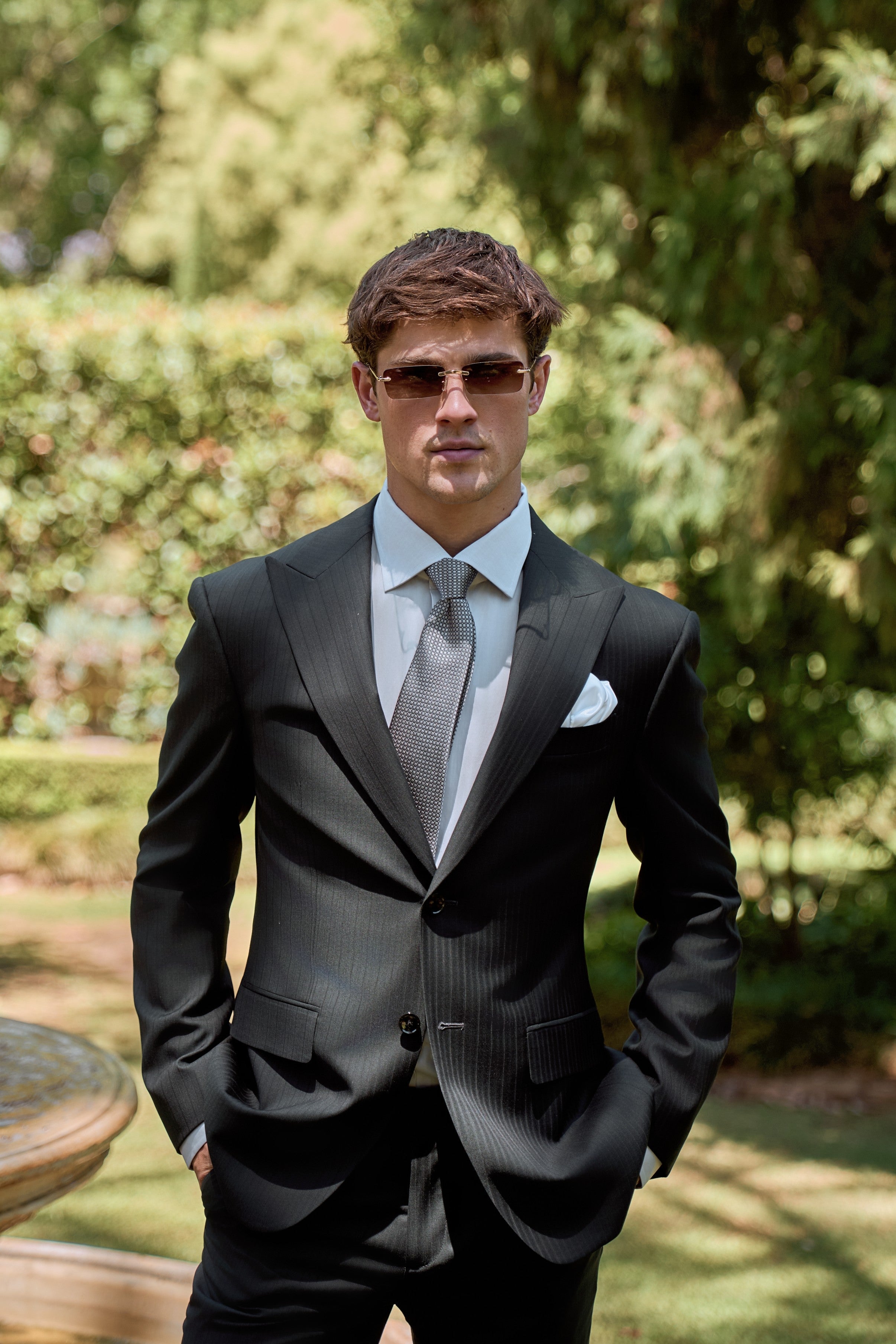
The weave of a cloth is its fundamental architecture. Plain weaves are crisp and smooth; twill weaves — which include serge and cavalry twill — have a diagonal rib that adds visual texture and structural resilience. Herringbone and houndstooth are traditional twill-based patterns that carry particular associations with English tailoring.
For a first suit in a plain or solid colour, the weave itself becomes the point of interest. A fine herringbone in charcoal, visible only at close range, communicates sophistication without ostentation. A windowpane check on a mid-grey cloth offers versatility with personality.
The traditional advice — to begin with a plain cloth — remains sound. It is not timidity; it is strategy. A well-made suit in plain navy or charcoal builds the wardrobe's foundation. Every subsequent commission can depart more adventurously from that base.
For Your First Suit Specifically
With all of the above as context, our recommendation for a first bespoke commission is consistent: a medium-weight worsted wool in the Super 100s to 120s range, in either a solid navy or charcoal, from a mill of recognised quality — Dormeuil, Scabal, Holland & Sherry, or Vitale Barberis Canonico among them.
This is not a conservative choice. It is an intelligent one. Such a cloth will be forgiving during the fittings process, which requires the fabric to be pinned, adjusted, and altered. It will reward the investment of bespoke construction with longevity. And it will serve across the widest range of occasions that your wardrobe will demand.
Once that first suit is complete — once you understand how a well-chosen cloth moves, how it ages, how it changes in different lights — the next commission becomes obvious. And the one after that. The fabric room is not a place of confusion; it is a place of education.
Cerroni Atelier — Fabric Selection Tips
— Always view cloth in natural light and artificial light before committing — the difference is significant, particularly with navy and dark cloths.
— Run your hand against the grain to feel the weight, not just the surface. A cloth should feel substantial without being stiff.
— Consider your climate seriously. If you live and work in a warm city, a 10oz cloth may prove impractical however beautiful it is.
— Avoid Super 160s and above for a first suit — the fineness makes them more delicate and less forgiving of the adjustments that bespoke requires.
— A plain cloth with an interesting weave — a fine herringbone, a subtle birdseye — gives you texture without pattern commitment.
— Ask your tailor which cloths they find rewarding to work with. Enthusiasm in the workroom produces a better suit.
The choice of fabric is, in the end, a choice about how you wish to be present in the world. A cloth speaks before the cut does, before the fit does, before anything else about a suit can be appraised. Choose it with the same care you would bring to anything that will accompany you through years of significant moments.
At Cerroni, every commission begins with that choice. We would be honoured to guide you through it.

Leave a comment
This site is protected by hCaptcha and the hCaptcha Privacy Policy and Terms of Service apply.